Who doesn’t printed love t-shirts? They’re cheap, comfortable and
best of all, they make a statement. Whether you’re an entrepreneur
looking for a business, an artistic stay-at-home mom or a teenager on
your summer break, t-shirts are a great way to have fun expressing
yourself and yes, to make money.
If you have no experience making printed t-shirts, some of the
following methods will require a fair bit of experimenting to get things
right. Costs can quickly add up with every mistake even if you’re using
cheap wholesale t-shirts, so I suggest your first task is to rummage
through your closet and garage and get out all those old tees to use as
test samples. Even old flat pieces of rags can be used to test small
areas of prints. If you make mistakes, then well, they’re rags anyway!
When you first start out making printed t-shrits, you’ll want to keep
your production low, concentrating on learning the techniques covered
here. You don’t want to overprint and have all your funds tied up in
keeping stock. Also, what I like about creating tshirts in small
quantities is that you’re free to use practically all sorts of paints
and dyes. Now, purists will shudder to hear me say that, but the fact is
even canned spray paints can be used to create wonderful effects.
We’ll be looking at 10 different methods of making printed t-shirts :
- Silk screen printing
- Hand painting
- Tie and Dye
- Stenciling and reverse stenciling
- Bleaching
- Airbrushing and spraying
- Stamping
- Iron ons
- Embroidery
- Online services
This is by far the most common method of printing t-shirts. Like every
other skill, it’s fairly easy to pick up but can take years to master.
It’s possible to set up a small tshirt printing workshop in your garage
using this method. Depending on the complexity of your projects (detail
and number of colors), a one man operation can print anywhere from 20 up
to 200 t-shirts a day. The good thing about silk screening your own
t-shirts is you can control almost every aspect of the quality of your
designs.
This post isn’t intended to be an indepth tutorial on screen printing
t-shirts, but I thought it might be a good idea to focus a bit on this
method since it is the most common technique of printing t-shirts. So if
you’re thinking of starting a silk screen t-shirt business, it’s good
to learn the basics of the following skills :
building your own screen frames or blocks,
including how to stretch the silk mesh across the frames with the
appropriate tension. Building strong durable screen frames are crucial
because you don’t want your screens to fall apart right in the middle of
a production run. Not only will that mean messy repairs, but it will
also screw up your delivery timing and affect ALL your other shirts
because building a new screen will require re-calibration and
registration of all your screens to make sure all the separate colors
line up correctly. You can skip this part altogether and just buy
ready-made silk screen frames. The advantage of getting ready-made
screen frames is that the silk is usually applied onto the frame with
equal tension all-round by a machine. This is one of the most difficult
things to achieve when applying silk onto frames by yourself.
Some links on how to make your own screen frames :
transferring your design to your silk screen frames.
The final quality of your prints will largely depend on this stage so if
you really want to go into screen printed tshirts, you’ve got to pay
attention to this process. This process requires a fair bit of
experimenting with photo emulsion and a light box to get it right, but
if once you learn the basic techniques, it’s basically a matter of
refining your skill with hands-on practice.
- color mixing. Colors can make or break your
designs. You need to learn the how different inks and dyes work and how
to mix them to create the specific hues that you need. There are lots of
different inks and dyes in the market, but to start off, it’s easiest
to use a mixture of print paster and ink. Just look at this page to see a
wide selection of print pastes and inks. This is a skill that takes lots of time to perfect and requires a good eye for color.
- printing. This is the fun part. You screen print
tshirts by forcing ink or dye through your silk screen mesh onto tshirts
with a squeegee. It’s best to start with one or two-color designs that
can actually be printed manually on a work tabletop, but eventually, you
will need to speed up the printing process and that will require
investment in printing presses that allow mutiple colored screens to be
attached to a “carousel” of clamps.
Here are a selection of videos to help you learn about screen printing t-shirts :
- curing your prints. Different types of ink and dyes (eg. dyes
that create puffy or rubberized dyes) require different curing
processes. This may involve anything from simply air drying to using
flash dryers that dramatically speed up the drying process.
More videos to help you get acquainted with how to dry your ink :
| Screen printing with a hand-held flash dryer
|
Screen printing flash dryer
|
While it’s possible to do everything yourself – from building your
screen blocks to creating your own stencils and actual printing – many
of these tasks can be outsourced to specialists. Outsourcing may cost a
bit more but can dramatically cut down on time and wastage. Many t-shirt
printers eventually hire staff to handle the printing processes because
they need to devote their time to the creative and administrative
aspects of their tshirt business.
Hand painting t-shirts are the easiest way to create t-shirts to sell.
Your canvas is the t-shirt itself and your tools are your creativity,
imagination, hands and paint materials. If you’ve got an artistic streak
in you, then hand-painting t-shirts will allow you lots of room to
express yourself and share your thoughts throught art that other people
can wear! There’s nothing to stop you from using any and every available
medium for your hand-painted t-shirts for example :
- T-shirt dyes
- Acryllic paints
- Spray cans
- Enamel paints
- T-shirt crayons
- Permanent colored markers
What you DO want to make sure is that the paint you use remains color
fast and will not wash off in the laundry. The worst thing that can
happen is your colors start to run and staining all of your customers
others clothes. The only way around this is to test-wash your
hand-painted t-shirts. You might also want to test-wash your
hand-painted t-shirts over a period of time to gauge how long each type
of paint will last. This can vary depending on your technique and brand
of paint used.
The obvious advantage to hand-painting t-shirts is that each t-shirt
will be uniquely different. There WILL be “imperfections” – as is the
case with any hand-painted craft – but these imperfections by themselves
are proof to buyers that they are getting uniquely created
“one-of-a-kind” t-shirts. Another advantage to producing hand-painted
items is that you are allowed a wee bit more leeway in how you charge
for each t-shirt.
Here are couple of examples of hand-painted t-shirts :
Watch a couple of videos on hand painting t-shirts :
| Hand painting a t-shirt
|
Brush painting on a t-shirt
|
Tie and Dye are popular with folks who love wearing bright
color-patterned t-shirts. There are countless ways to fold a t-shirt
which is then tied or bound with string or rubber bands. When dye is
applied to the t-shirt, the tied areas restrict the dye from penetrating
the fabric’s fibres and the results is a mesmerizing array of colors in
wonderful patterns.
The great thing about tie and dye t-shirts is that NO two shirts will
ever look alike, so if you’re thinking of “UNIQUE” as a selling point,
then this is really it. Your customers will love knowing that their
t-shirt is truly a one-and-only creation.
Learning how to tie and dye and be really fun. Practice with lots of
old t-shirts because you’ll want to know how different types of fabric
react and produce different patterned hues when applied with different
concentrations of dye. While tie and dye is usually thought of as a
kiddie craft, I assure you that with a bit of creativity, lots of
dunking and experimenting and elbow grease, you CAN make money selling
bright, beautiful tie and dye t-shirts.
Great looking tie and dye t-shirts
More tie and dye t-shirt examples
The tie and dye process
Ready to start tien’ n dyen’? Then here are a couple more resources and videos :
Learn how to make tie and dye masterpieces
Learn how to tie and dye t-shirts
| How to tie-dye t-shirts
|
Tie dye circle patterns
|
Stencilling is sort of the poor man’s version of silk screening.
Instead of transferring stencils onto silk screens, images or patterns
are simplified and cut out on paper. The stencil is then taped onto the
t-shirt and paint applied onto the stencil. The stencil will only allow
the paint onto the exposed areas – thereby creating your image on the
t-shirt. Reverse stencilling is simply the reverse technique where your
stencil blocks the main image from being painted.
The biggest advantage to this method is obviously the savings in
money. Hand printed stencils produce a slightly rough edged look that
many people desire. There are however quite a number of disadvantages to
this method. It’s time consuming and the stencils usually cannot be
used for more than a dozen prints without some sort of deterioration in
quality of the stencil as well as image. However, if you’re thinking of
printing one-off custom t-shirts for customers, then this is a very cost
effective method.
Creating stencils to paint on t-shirts
Stencil for spray painting – quick and fun
Decorate and personalize t-shirts for kids
The best way to get an idea on how stencilling is done is to watch it :
| Stencil your own t-shirt |
Reverse Stencil
|
I really love this method of making t-shirts. Bleaching t-shirts is
actually the reverse of screen printing. In screen printing, you apply
dye onto t-shirts via the opening in silk screen or hand made stencils.
To bleach t-shirts, you REMOVE the dye pigment from the t-shirt by
applying either a bleach solution or discharge paste to the opening in a
stencil. Think about it as controlled staining. If you don’t want to
use a stencil, you can paint the bleach paste directly onto your tee,
but that’s a wee bit risky. What I love about this method is that it can
be used to produce great effects depending on what you use to mask the
bleach/paste and how you apply it.
More information and videos about t-shirt bleaching :
This t-shirt creation method is an extension of the hand-painting
method (#2). Airbrushing and spraying on t-shirts requires a fair degree
of skill and experience because mistakes usually mean money down the
drain. However, the benefits of airbrushed t-shirts are obvious. Each
creation has that hand crafted “masterpiece” look so buyers can proudly
proclaim that their tee is a unique one-of-a-kind. Remember again that
if you’ve built a reputation and name around your artwork, air-brushed
t-shirt masterpieces can sell for a lot of money. Learning the basic of
air-brushing is easy. It’s getting the subtle nuances and color blending
that can take years to get right. If you’ve been airbrushing for some
time, you might want to consider t-shirts as an alternative (and
lucrative) way to make money. However, if you’ve never held an airbrush
before, fret not. Airbrushing is taught in many art schools as a short
course. There are also lots of how-to videos and books that teach you
the art of airbrushing. To get you started, here are a couple of links
and videos to help spark the airbrush t-shirt artist in you
We’ve all done this in craft class although we never used t-shirts as
our canvas. This is the most basic of t-shirt printing techniques. Using
any object with a flat surface that can be applied with ink or dye as a
stamp – cut veggie, leaves, twigs, string, rubber stamps, your hands
and feet etc. – dip them in fabric dye and just stamp out a pattern or
design on the t-shirt. Stamping is easy and even your kids can join in
to help create “limited edition” designs that you can sell. Obviously
the biggest drawback to this technique is that it can easily go wrong
and you end up with a messy print job, but if you practice on old rags,
you should get the hang of it. You can customize your stamped t-shirts
by stamping the buyer’s name on it.
Great videos to learn creative ways to stamp t-shirts :
Making a fireworks t-shirt
Making a slam-dunk design on t-shirt
Thumbprinting on a t-shirt
Friendly face t-shirt
More information and ideas for stamping in the following links :
Fabric stamping tips and techniques
Decorating t-shirts with rubber stamps
One of the easiest ways to create designs for t-shirts if to print them
on iron-on transfers and heat transfer them to the t-shirt. The great
thing about iron-on designs are that they are relatively easy to
produce. If you’re skilled at graphic design, then you already have a
big advantage. You don’t need any sewing skills and you don’t have to
learn the exacting skills of screen printing. The biggest disadvantage
of iron-ons is that they can have a very short life-span if the t-shirts
they are on are subject to vigorous wear and wash as opposed to screen
printed shirts where the dye penetrates the fabric’s fibers permanently.
The other small downside to iron-ons is that you will require special
equipment to produce your designs although most of this will be a
one-time cost. The consumables (iron-on transfer sheets) can be
purchased as and when you need them.
You will need the following :
- Software (to design your t-shirt or other iron-on transfer)
- Printer
- Iron (or heat transfer press)
- Transfer paper (tips, types, sources)
Another advantage of iron-on transfers is that you can concentrate on
producing just the designs on iron-on transfer sheets and sell them to
your customers. You don’t have to worry about keeping t-shirts in stock
and you can send your iron-on transfers by envelope (make sure to use a
cardboard backing so the iron-on sheet won’t get crumpled or damaged at
the edges). Remember to include detailed instructions on how to transfer
the designs on to t-shirts – or you’ll be getting loads of complaints.
Here are some links and videos to learn more about t-shirt iron-on transfers :
Learning to print iron-on transfers for t-shirts
A great series of videos on iron-ons for t-shirts
FREE designs you can use on iron-on transfers
| Types of iron-on transfers
|
How to create iron-on transfer
|
Embroidery isn’t the most cost effective way of creating designs for
t-shirts (not your regular comfy cotton t-shirts anyway). You can hand
embroider designs on t-shirts by hand but that would be a very time
consuming task. These days, embroidery machines are more commonly used
to stitch on logos and small designs for corporate identity. Other than
t-shirts, embroidery can be used to personalize caps, bags, shoes etc.
It’s also possible to embroider iron-on patches that you can either sell
as is or transfer to t-shirts. The biggest drawback to embroidery is
that you will require an embroidery machine or at the very least a heavy
duty sewing machine and this will cost you money. You will then need to
familiarize yourself with operating the machine.
for practical call +2349030701684


 The lady who itemized what she was wearing and where she got them from, wrote; Hair: Akinlapa Marker Ibadan. Shoe: I can’t remember see Jacket: Ikeja Under bridge Singlet: Dugbe Market.
See screenshot below:-
The lady who itemized what she was wearing and where she got them from, wrote; Hair: Akinlapa Marker Ibadan. Shoe: I can’t remember see Jacket: Ikeja Under bridge Singlet: Dugbe Market.
See screenshot below:- SOURCE:

 - Uko said Nnamdi Kanu had accepted restructuring over absolute Biafra when Nigerian Army attacked
- Kanu was reportedly consulting with top members of IPOB over the matter when Army attacked
- Professor Ben Nwabueze was the one that convinced Kanu during a meeting between him, southeast governors and other leaders in the region.
A southeast leader Evang. Elliot Uko has said that the Nigerian Army attacked the Indigenous People of Biafra (IPOB) just when it was about to tone down on its agitation for sovereignty. According to The Nation, Uko, the deputy secretary of Igbo Leaders of Thought, said Kanu had accepted at a governor with the meeting (where he was present) to reduce his pro-Biafra activities. Uko said in a statement he released on Friday, September 22 truly Prof. Ben Nwabueze had convinced Kanu to drop call for Biafra and accept restructuring instead. Kanu, he said, had accepted the idea on the condition that he consult with his group members.
Read more:
- Uko said Nnamdi Kanu had accepted restructuring over absolute Biafra when Nigerian Army attacked
- Kanu was reportedly consulting with top members of IPOB over the matter when Army attacked
- Professor Ben Nwabueze was the one that convinced Kanu during a meeting between him, southeast governors and other leaders in the region.
A southeast leader Evang. Elliot Uko has said that the Nigerian Army attacked the Indigenous People of Biafra (IPOB) just when it was about to tone down on its agitation for sovereignty. According to The Nation, Uko, the deputy secretary of Igbo Leaders of Thought, said Kanu had accepted at a governor with the meeting (where he was present) to reduce his pro-Biafra activities. Uko said in a statement he released on Friday, September 22 truly Prof. Ben Nwabueze had convinced Kanu to drop call for Biafra and accept restructuring instead. Kanu, he said, had accepted the idea on the condition that he consult with his group members.
Read more:
 Love at First Click
 Printed for Tabula Rasa Magazine.
 One reason I look for that care is because I think for someone to
make something that's going to last, there is undoubtedly an amount of
love as well as skill that goes into that. And things that last are
important. I'm happy to pay more for something if I see it as an
investment. I would rather spend £80 on a saucepan if it means that I'll
be buying one that lasts. I've always felt that about things, rather
than thinking something is too expensive. I've noticed that the French
think like that about clothes – they'll have fewer but better quality.
Even when I had no money I'd save up and travel to London to buy a
Cacharel shirt. It's about knowing what you want and saving for it. I
have a 1980s Bang & Olufsen portable radio – the sound is so good,
the design is very streamlined and it's visually so nice. Good quality
rides over to everything, though. It can be apparent in something like a
cotton T-shirt that has faded well – it doesn't have to be expensive. I
prefer clothes that get better with age – cotton raincoats that get
softer, moleskin that wears in well. We should respect what it takes to
produce something that is of a quality to last, and I feel we should be
thinking about that now, especially in terms of protecting the
environment. We should be more careful with our water, with everything.
One reason I look for that care is because I think for someone to
make something that's going to last, there is undoubtedly an amount of
love as well as skill that goes into that. And things that last are
important. I'm happy to pay more for something if I see it as an
investment. I would rather spend £80 on a saucepan if it means that I'll
be buying one that lasts. I've always felt that about things, rather
than thinking something is too expensive. I've noticed that the French
think like that about clothes – they'll have fewer but better quality.
Even when I had no money I'd save up and travel to London to buy a
Cacharel shirt. It's about knowing what you want and saving for it. I
have a 1980s Bang & Olufsen portable radio – the sound is so good,
the design is very streamlined and it's visually so nice. Good quality
rides over to everything, though. It can be apparent in something like a
cotton T-shirt that has faded well – it doesn't have to be expensive. I
prefer clothes that get better with age – cotton raincoats that get
softer, moleskin that wears in well. We should respect what it takes to
produce something that is of a quality to last, and I feel we should be
thinking about that now, especially in terms of protecting the
environment. We should be more careful with our water, with everything. Hand in hand with good manufacture is having an edited approach to
dressing. I like to have only a few clothes in the wardrobe that I wear
and wear. I'm not somebody who has lots of different things (apart from
notebooks – I'm a sucker for stationery). In design, I prefer to get
something right rather than the more commercial attitude of doing it in
lots of different colors. I really don't like that thing of going and
buying very cheap clothes and throwing them away.
Hand in hand with good manufacture is having an edited approach to
dressing. I like to have only a few clothes in the wardrobe that I wear
and wear. I'm not somebody who has lots of different things (apart from
notebooks – I'm a sucker for stationery). In design, I prefer to get
something right rather than the more commercial attitude of doing it in
lots of different colors. I really don't like that thing of going and
buying very cheap clothes and throwing them away. Recently the Made In Britain campaign has been getting louder. On the
whole I'm in favour of it, but I don't think you can put back the
clock. I wouldn't suddenly let down the manufacturing we do elsewhere
simply to be made in Britain: we go where the work is good, it's a
global industry now. One wants to support those who make a great
product. Our knitwear is made mostly in Scotland.
Recently the Made In Britain campaign has been getting louder. On the
whole I'm in favour of it, but I don't think you can put back the
clock. I wouldn't suddenly let down the manufacturing we do elsewhere
simply to be made in Britain: we go where the work is good, it's a
global industry now. One wants to support those who make a great
product. Our knitwear is made mostly in Scotland.

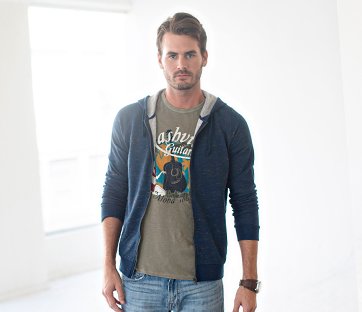
 Make getting dressed everyday fashionable and fun with all
the top clothing brands at amazing prices right here! Everywhere you go
and no matter what you do, there is an outfit that is perfect for the
occasion. From casual and comfy clothing to elegant and dressy, every
article of clothing has a purpose and a place within your closet and
your life. With infinite outfit possibilities and occasions, how can one
keep up with today's trends and impromptu parties while staying super
stylish? We've got the answer! Name-brand clothing can be yours with the
massive selection at 6pm.com! Looking for a new T-shirt? Browse this
awesome selection of tees for men, women and kids! Need some jeans to go with that new shirt? We've got some hot styles from brands like 7 for All Mankind or Hudson.
If you're shopping for a friend, family member or significant other,
you're in luck! 6pm.com carries clothing of all different styles and
tastes! Every woman has her own style. Some dressy, some high-fashion,
some laid-back and some business-like. Whatever your personal style,
adding sleek pieces from Calvin Klein and an assortment of London Times dresses can significantly help your daily what-to-wear dilemma. click for more
Make getting dressed everyday fashionable and fun with all
the top clothing brands at amazing prices right here! Everywhere you go
and no matter what you do, there is an outfit that is perfect for the
occasion. From casual and comfy clothing to elegant and dressy, every
article of clothing has a purpose and a place within your closet and
your life. With infinite outfit possibilities and occasions, how can one
keep up with today's trends and impromptu parties while staying super
stylish? We've got the answer! Name-brand clothing can be yours with the
massive selection at 6pm.com! Looking for a new T-shirt? Browse this
awesome selection of tees for men, women and kids! Need some jeans to go with that new shirt? We've got some hot styles from brands like 7 for All Mankind or Hudson.
If you're shopping for a friend, family member or significant other,
you're in luck! 6pm.com carries clothing of all different styles and
tastes! Every woman has her own style. Some dressy, some high-fashion,
some laid-back and some business-like. Whatever your personal style,
adding sleek pieces from Calvin Klein and an assortment of London Times dresses can significantly help your daily what-to-wear dilemma. click for more


